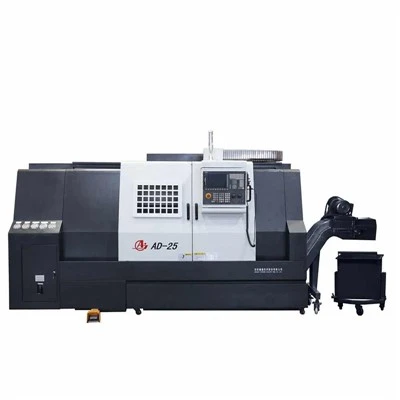
If you’ve ever stood next to a slant-bed CNC lathe in a production shop—whether it’s humming quietly through a 24/7 run of precision automotive parts, a mold maker tweaking a custom cavity, or a job shop cranking out prototype brackets by the dozen—you know how much time and money depend on that machine staying online. No breakdown means no missed deadlines, no rushed rework, no lost customer trust. That’s why I get questions all the time, from new machinists and veteran shop managers alike: Does the AD Slant-bed CNC Lathe have a built-in diagnostic system? AD Slant-bed CNC Lathe

I’m the guy who fields those questions every day, too—one of the sales and support leads for AD’s slant-bed CNC lathe line, and I’ve spent the last 12 years working with these machines, from the first prototype that rolled out of our factory to the units running in shops across North America and parts of Europe. I’ve sat through late-night breakdown calls with customers, helped technicians troubleshoot a weird code that popped up mid-cycle, and walked a new shop owner through their first diagnostic check after a startup. So when someone asks if our lathes have built-in diagnostics, my answer isn’t a quick yes or no—it’s a breakdown of what that actually means, how our system works, and why it’s one of the most underrated features of the AD Slant-bed line.
Let’s start with what most people mean when they say “built-in diagnostic system” for CNC machines. Back in the 1990s and early 2000s, a lot of lathes came with basic alarms—if a servo motor overheated, you’d get a red light, and that was it. You’d pull the manual, flip through pages to figure out what the code meant, and then cross your fingers it wasn’t a part that would take two hours to replace. Today’s diagnostics aren’t just alarm codes; they’re real-time data feeds, prescriptive alerts, and tools that let you catch issues before they turn into downtime. For AD, that’s exactly what we built into our slant-bed lathes, and it’s tailored specifically to how our customers work.
First, let’s talk about the core hardware that makes this possible. Every AD Slant-bed CNC Lathe comes equipped with a Fanuc or Siemens control panel (two of the most widely used controls in the industry, so machinists don’t have to learn a new system) paired with our proprietary AD Link monitoring module. This module is mounted directly on the lathe’s spine, not tucked away in a corner where it can get shaken by vibration or coated in coolant mist—we designed it to hold up to the harsh conditions of a production floor, not just the clean test floor in our factory. From there, it pulls data from every critical component: spindle bearings, servo motors, tool changers, coolant pumps, even the linear guides that the turret slides on.
Here’s how that works in practice. If you’ve ever run a CNC lathe, you know spindle health is non-negotiable. A worn spindle can throw off part tolerance, ruin a $500 tool bit, or even damage the workpiece. Our diagnostic system tracks spindle vibration, temperature, and load in real time. For example, if a spindle’s vibration spikes just 10% above its normal operating range during a roughing cut, the system doesn’t just flash an alarm—it shows a graph of vibration over the last 10 hours, compares it to our baseline data from thousands of AD lathes in operation, and flags that “you might have a slight imbalance in the spindle head” or “one of the bearings is starting to wear.” That’s not a guess; that’s data. We didn’t just add a generic sensor—we trained the system on AD-specific machine data, so it knows what “normal” looks like for our lathes, not just a one-size-fits-all average.
Then there’s tool monitoring, which is a huge pain point for almost every machine shop. If a tool breaks mid-cut, you not only ruin the part, you lose 10, 15, even 30 minutes while you swap tools and re-home the machine. Our built-in diagnostic system tracks tool load and wear through the spindle’s power draw. When you program a cut, you input the tool type, material, and depth, and the system calculates what the power draw should be for that specific operation. If the power draw jumps 20% higher than expected mid-cut, that tells the system the tool is chipping or breaking. It can either pause the machine automatically and alert the operator, or if you’ve programmed it for lights-out runs, it can trigger the tool changer to swap in a backup tool and finish the cycle. We had a customer in Detroit last year who runs 10 AD slant-bed lathes for automotive brake components; they told us since turning on the tool diagnostic feature, their tool-related downtime dropped by 60% in six months. That’s not a sales pitch—that’s actual shop data.
But diagnostics aren’t just for big issues, either. The system also catches small, easy-to-fix problems before they become big ones. For example, if the coolant level in the spindle reservoir is getting low, the system will send a low-priority alert to the operator’s screen—no shutdown required, just a note to top it off during a break. If the air line to the tool changer has a small leak that’s reducing pressure, it will track that over a week and alert the maintenance team to fix it during a scheduled downtime window, not when the tool changer fails mid-production. We built our diagnostic system to reduce unplanned downtime, not just alarm operators at the worst possible time.
A common question I get from small job shops, which might only have one or two maintenance techs on staff, is: “Does this require a fancy IT team or a super machinist to use?” The short answer is no. We designed the interface to be intuitive, not cluttered with data no one needs. The main screen has three simple sections: Real-Time Alerts, Health Summary, and Trend Data. The Real-Time Alerts section only shows active issues, with a plain-language explanation—instead of a code like “ALM 047: SERVO OVERLOAD,” it says “Servo motor for turret is drawing extra power; possible obstruction.” The Health Summary gives a quick green/yellow/red indicator for each major component, so even a shop foreman who isn’t a CNC expert can glance at the screen and know if everything is okay. The Trend Data section is for more in-depth troubleshooting, and we offer free 90-minute training for every customer when they pick up their lathe—we don’t just ship the machine and disappear. We also have a dedicated support line for our diagnostic system, so if a customer is confused about an alert, they can call us anytime, day or night, and walk through it with one of our technicians.
Now, let’s address the elephant in the room: can the diagnostic system connect remotely? Yes, and we get a lot of feedback on that. Many of our mid-sized and large customers use the remote monitoring feature to check their lathes while they’re at home, on vacation, or managing other parts of their business. If an alert comes in, they can log into their AD portal from their phone and see exactly what’s wrong, instead of having to drive 45 minutes to the shop at 7 a.m. on a Sunday. Remote access also cuts down on service calls: in many cases, our technicians can diagnose an issue remotely, walk the operator through a fix, and have the machine back up in 15 minutes, instead of sending a service tech out for a minor problem. That’s a huge cost saver for customers, especially those in rural areas where service response time can be slow.
I want to be transparent, though—no diagnostic system is perfect, and we’ll be the first to tell you that. Our system works best when it’s set up correctly, when operators follow the routine maintenance checks we outline, and when the machine is used as designed. If someone modifies the lathe beyond our specifications—like using a non-AD tool holder that’s not calibrated correctly—the system might not pick up an issue right away, because it’s relying on data from our original components. That’s why we always tell customers that diagnostics are a tool, not a replacement for regular maintenance and trained operators. The best diagnostic system in the world won’t fix a machine that’s not being oiled or cleaned properly.
Let’s also talk about what this means for different types of users. If you’re a new shop owner just starting out, our diagnostic system takes a lot of the guesswork out of running a CNC lathe. You don’t need a team of expert machinists to catch when something is wrong; the system gives you clear guidance. If you’re a large production shop, it lets you optimize your schedule, plan downtime, and reduce the cost of unplanned repairs. For prototype shops that run short runs of custom parts, it helps you avoid ruining expensive prototype materials because of an unexpected machine issue.
I’ve seen this system work firsthand, not just in our testing labs, but in real shops. Last year, I visited a small mold-making shop in Ohio that had two AD Slant-bed lathes. The owner told me that three months before, they would have lost a $2,000 mold cavity because a spindle was starting to wear, but the diagnostic system flagged the vibration spike, and their maintenance tech swapped the spindle during a scheduled break instead of during a run. That’s the kind of impact we designed for. It’s not about adding a fancy feature to make the machine look better on paper; it’s about giving our customers the tools to run their business more smoothly, more profitably, and with less stress.
At the end of the day, when a customer asks “Does the AD Slant-bed CNC Lathe have a built-in diagnostic system?” my answer is a resounding yes—but with context. It’s not just a set of alarm codes; it’s a real-time, data-driven tool tailored to the harsh realities of production machining. It’s built to be used by machinists, not just engineers, and it’s backed by our team of support technicians who are just a phone call away. If you’re in the market for a slant-bed CNC lathe, don’t just look at speed or tolerance specs—ask about the diagnostic system, because downtime is the single biggest cost for most machine shops.
If you’re ready to learn more about how our built-in diagnostic system can work for your shop, we’re here to help. Our team can walk you through the feature set, share real customer case studies, and answer any questions you have about how AD Slant-bed CNC Lathes can reduce your downtime and improve your productivity. We don’t push one-size-fits-all solutions; we work with you to understand your specific needs, whether you’re a small job shop or a large production facility. Reach out to our team today to schedule a consultation and discuss your CNC lathe requirements.
AD Slant-bed CNC Lathe References
- The Association for Manufacturing Technology. (2022). CNC Machine Diagnostics: Best Practices for Reducing Unplanned Downtime.
- Fanuc Corporation. (2021). Integrated Monitoring Systems for CNC Lathes and Machining Centers.
- Siemens AG. (2023). Condition Monitoring for Machine Tools: Real-Time Data and Prescriptive Maintenance.
- AD Machine Tools Internal Engineering Documentation. (2024). Slant-bed CNC Lathe Diagnostic System Design and Performance Testing.
Anyang Xinsheng Machine Tool Co., Ltd.
We’re well-known as one of the leading ad slant-bed cnc lathe manufacturers and suppliers in China, featured by quality products and good price. Please rest assured to buy advanced ad slant-bed cnc lathe made in China here from our factory. Contact us for more details.
Address: No.68 Renmin road, Anyang, Henan, China
E-mail: sales@anyangst.com
WebSite: https://www.xslathe.com/
